Giorno 7 — Ste Rose du Nord → Tadoussac → Baie Ste Catherine → La Malbaie → Ste Anne de Beaupre → Quebec City
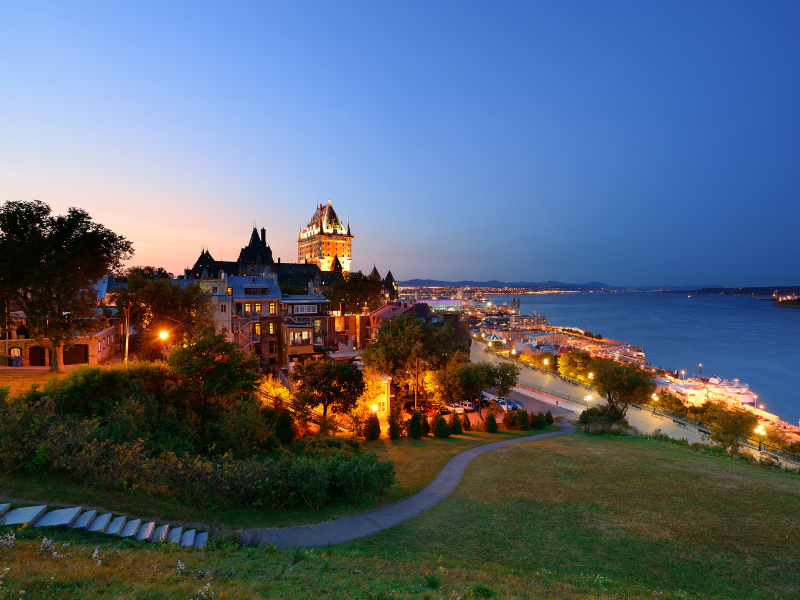
Tadoussac is a picturesque village in Québec, set where the Saguenay River meets the majestic St Lawrence, in a scene of extraordinary beauty. Considered one of the oldest European settlements in North America, it preserves historic charm with its wooden chapel and the iconic hotel overlooking the bay. Tadoussac is famous above all as one of the world's best whale-watching locations: in the plankton-rich waters of the estuary swim belugas, minke whales and even blue whales, observable on boat or zodiac excursions. The nearby Saguenay fjord, with its steep walls, offers spectacular panoramas and unforgettable cruises. Sand dunes and coastal trails complete the natural offering. Between fjords, whales and history, Tadoussac is a fascinating and evocative destination, a jewel of the Québec coast. Baie-Sainte-Catherine is a small Québec village set on the north shore of the St Lawrence, right at the mouth of the majestic Saguenay Fjord, across from famous Tadoussac. Its strategic position makes it one of the best departure points for whale-watching cruises, with whales frequenting the cold, rich estuary waters in numbers, from small white belugas to mighty rorquals. From here also departs the ferry that crosses the fjord. The village offers a serene and authentic atmosphere, facing grand scenes where the fjord meets the great river. Between whales, fjord and sunsets over the water, Baie-Sainte-Catherine embodies the enchantment of Québec's Côte-Nord. La Malbaie is a town in Québec, the heart of the picturesque Charlevoix region, set on the banks of the St Lawrence River in a scene of hills and landscapes of great charm. A historic holiday resort, it is famous for the sumptuous Fairmont Le Manoir Richelieu, an elegant hotel-castle overlooking the river with its casino, a symbol of the area's refined tourism since the nineteenth century. The Charlevoix region, recognised as a UNESCO biosphere reserve, offers spectacular panoramas, farms, terroir flavours and a landscape shaped by an ancient meteorite crater. Nearby you can hike, watch whales along the coast and visit picturesque villages. Elegant and set in evocative landscapes, La Malbaie combines refinement, nature and gastronomy, one of the most fascinating destinations in the splendid Charlevoix region. Sainte-Anne-de-Beaupré is a famous Québec village, set along the north shore of the St Lawrence a short distance from Québec City, known across North America as an important place of pilgrimage. The heart of the village is the majestic Basilica of Sainte-Anne-de-Beaupré, an imposing neo-Romanesque shrine with splendid stained glass and mosaics, visited each year by hundreds of thousands of faithful and visitors and considered one of the most important sacred sites on the continent. The village stands in a region of great beauty, near the spectacular Montmorency Falls and the scenic road of the Côte-de-Beaupré. The surroundings offer scenes between river and mountains. Between faith, art and nature, Sainte-Anne-de-Beaupré embodies a solemn and evocative corner of Québec. Québec City, capital of the eponymous province, is the most European city in North America, the only one north of Mexico to have kept its fortified walls, recognised as a UNESCO World Heritage Site. Set on a promontory above the St Lawrence River, it is dominated by the unmistakable silhouette of the Château Frontenac, a sumptuous hotel towering over Vieux-Québec. The cobbled streets of the old town, divided into Haute-Ville and Basse-Ville, enchant with their stone houses, boutiques, cafés and Francophone atmosphere, especially magical under winter snow. The Petit-Champlain district, among the oldest on the continent, and Place Royale preserve the charm of New France. The Terrasse Dufferin offers scenic walks over the river, while the gastronomy celebrates Québec cuisine. Romantic, historic and uniquely characterful, Québec City is a city to be explored on foot, among fortifications, alleys and old-world atmospheres.
_20260331114555.png)
_20260331114555.png)
_20260331114555.png)